Powered By Blogger

Tuesday, November 29, 2016

Do You Remember Kony 2012?

In March of 2016 Invisible Children, a non-profit organization, launched a 30-minute documentary that quickly went viral. Within five days of its release, it had over 100 million views and, at the time, was the most-watched viral video of all time. In the years since it has come to light that many of the claims made in the campaign had been exaggerated in order to sensationalize the story and raise more money. Although the Kony 2012 campaign may have made some young people more suspicious of these types of viral marketing, it also proved how successfully a cause can be spread via social media.  Campaigns like the Ice Bucket challenge have been able to harness this power as well to tremendous effect.


Focusing on the African country of Uganda and the damage caused by the Lord's Resistance Army (LRA), the documentary spread rapidly via Facebook and Twitter shares. It documented the path of destruction left by the LRA and its leader Joseph Kony. It urged the viewers to join the cause to raise awareness of these heinous acts. The goal was to stop Kony's reign of terror through donations and a widespread guerrilla marketing campaign in the United States. The campaign was massively successful and raised over $12 million via merchandising and individual donors. Supporters could purchase "action kits" for $30 which included stickers, t-shirts, and posters all meant to spread the message of the Invisible Children organization.

Joseph Kony

I first heard about the Kony 2012 campaign on Facebook. I remember seeing all of my friends sharing the video and eventually it piqued my curiosity. I took the time to watch it and found that the short film was very well done and quickly grabbed my attention. After finishing the video I was excited to join the movement and see what I could do to help the cause. Fortunately, after some thought, I decided against it and eventually forgot about the campaign altogether. It wasn't until weeks later that I realized that I hadn't heard anything on social media or from my friends about the campaign. Although it had raised a tremendous amount of money very quickly, it seemed to die off just as quickly as it had started. 


Years later I looked back on this fad and began to do a little research on what had happened to the organization. I found out that although the organization had raised well over $10 million it did not donate this money to help the victims of the LRA and Joseph Kony, instead this money was used to raise "awareness". This meant creating more films and essentially trying to make more money for the Invisible Children organization. To make things worse for the organization its founder, Jason Russell, had been arrested for public masturbation and auto-vandalism only a few weeks after the video's initial release.

The true downfall of Kony 2012 may have been its over simplification of the issues and it's clear sensationalism. The creators of the movement failed to present a well rounded story and instead presented a very one sided and narrow minded narrative that may have hurt the Ugandan people more than it helped. By sensationalizing the effect of the LRA at the time, as well as advocating for an increased military presence in an already heavily militarized area the Kony 2012 campaign could have easily made the situation worse. Fortunately, the campaign seems to have had little effect on the area even four years later.

The legacy of the Kony 2012 movement is one of disappointment and dishonesty. For many of the young people who donated money to the cause and put in many hours doing their part to raise awareness the Kony 2012 movement serves as a reminder of the importance of research before supporting as political cause or candidate. Although it had such a negative effect on so many individuals views of nonprofits and viral marketing, Kony 2012 paved the way for a whole new way to raise funds. By demonstrating the overwhelming power of an engaging social media campaign, Kony 2012 set the stage for many of the massive social media causes we see today.


Sunday, November 27, 2016

Thanksgiving in the Finch Household


Like many families in the United States, the Finch's love to celebrate the Thanksgiving holiday. It is a time when we gather together our friends and family to give thanks for the blessings we have received in the previous year. Although we don't seem to have any traditions that are out of the ordinary, we still add a bit of our own twist on the standard Thanksgiving celebration.

One constant in the Finch family Thanksgiving meal is a sweet potato casserole made by my mother. She began making the dish six or seven years ago after visiting a Ruth's Chris Steakhouse and trying their wonderful brown sugar sweet potato casserole. She was able to find a recipe for the dish and it has been a hit ever since.

Although my Grandparents didn't celebrate at our home this year, they are a usual fixture at our Thanksgiving dinner table. They always bring a few Tupperware containers full of my Grandmother's award winning (yes, they've actually won awards) cookies. Whether it's the chocolate chip or cherry filled cookies, eating too many of them has become one of my favorite Thanksgiving traditions.


The final strange tradition that we have at my home is that every year my brother and I go out to our
range and shoot. This isn't an intentional tradition, but instead it seems that every year we take a few pistols and rifles to our outdoor range and empty a couple boxes of ammo. I'm not sure why we always do it on Thanksgiving, but this is something that we've been doing since I first left for college 3 years ago. We always have fun and it's a great way to blow off steam. Perhaps this started after we stopped playing backyard football on Thanksgiving.

Looking back at my family's Thanksgiving traditions I can see a parallel between these unique traditions and the principles of marketing. Just as I associate these traditions with spending Thanksgiving with my family, all consumers hold strong associations with products and events. By playing to these associations it is easy to grab an individual's eye and to influence them to engage with your brand.

You've Been Nudged


If you've ever read Nudge by Richard H. Thaler and Cass R. Sunstein then you are very familiar with the idea of choice architects and the ways that they structure decisions to modify your behavior. These small, subliminal influences are present in our everyday lives and are often difficult to spot. For this post, I'm going to point out a few "nudges" that I see in my everyday life and analyze how they affect my behavior.

1. Miller Dining Hall

If you have been to the Miller Dining Hall since it was remodeled a couple years ago, then you are probably aware of the entirely new layout that has been implemented. By spreading the food into a variety of different themed locations, not only did Miller become more aesthetically appealing, it also serves another purpose. By spreading the food around the dining hall and using smaller serving dishes and utensils, Miller has been able to dramatically reduce the amount of food that is wasted every day. Although this change was very small and has little effect on most diners experience, it was very succesful in nudging them into a desired behavior. This article from The Exponent has more information on the environmentally friendly changes made in the Miller Dining Hall.

2. Safeway


As we all know, many stores place small items such as candy or gum near the register in an effort to influence consumers to purchase these items at the end of their trip. I don't think of myself as particularly influenced by this approach, but by placing the dairy, deli, bakery, and produce on different sides of the store Safeway has found my weakness. As I walk from one side of the store to the other it is very rare that I don't stop to pick up something that not only I hadn't intended to get, but don't need. Some perfect examples being: chips, beer, ice cream, and tortillas. All of these products are placed at the outside of each row and easily catch my eye when I am walking around the store. Although I am aware that this is done on purpose, I am still unable to overcome the urge, therefore falling into the nudge created by the choice architects.

3. Email Enrollment


How many times have you received emails and newsletters from companies and organizations that you didn't realize you had signed up for? If you are like me, then this is a weekly occurrence. Often when ordering a product or making an account on a website you are faced with a variety of checkboxes. Sometimes these are already checked and other times you are forced to check them yourself. In my experience, many boxes concerning signing up for an email newsletter are already checked and require the user to opt out. By forcing customers to opt out these companies are nudging customers to enroll in their newsletter so that they can continue to influence the user to return to purchase more products. I often fail to notice the box and therefore fail to opt-out, allowing the company to harass me with daily emails.

Tuesday, November 1, 2016

The Worst Ski Boots I've Ever Owned

Unfortunately in life sometimes things just don't live up to your expectations. This is very true in purchasing products and services, as all too often the packaging or a product's ads can easily make a product seem to be more than it really is. Besides the actual misleading marketing of the company, occasionally the reviews of other purchasers lead to a misconception of the product, and in the end disappointment.

Possibly the worst product that I've ever spent a considerable amount of money on, and certainly the worst pair of ski boots I've ever purchased were the Full Tilt Seth Morrison Pro Models I purchased in 2011. I bought them and almost immediately began having problems with them. I broke all six of the buckles and was forced to replace all six cables due to a terrible fit. Never before had I been so disappointed in a product that I had spent more than $500 on.

Before I dig into the reasons that I think caused this terrible product failure and disappointment, first a brief history on the boot. Originally popular in the 1980's the Raichle Flexon series of boots was the first ski boot to utilize a "3-piece articulated design". At the time this was considered revolutionary and the company was very successful. This success lasted into the 90's until the company fell upon hard times and was bought out. The company was renamed and the Flexon design was archived and eventually sold. It bounced around from company to company until in 2006 Full Tilt purchased the molds and began manufacturing the old design.

These boots were made to be lighter, cheaper, warmer, more comfortable, and easier to take on and off than the standard 2-piece boot. Ski magazines and reviewers began to rave about the boot and its fantastic design. Finally, in 2012 I broke down and decided to buy a pair for myself. I should have known right away that they were not a good purchase because I had to buy and return three different pairs before I could get a pair that fit correctly. After finally getting boots that fit, I immediately went out for a day on the slopes.


Three-Piece Boot vs. Two-Piece Boot
Unfortunately, I soon discovered other flaws in the boots design. Because of the boots use of cables and adjusting buckles it became very easy for the buckle to become frozen after a day of skiing. Once the buckle froze, it became impossible to adjust and once unbuckled, couldn't be buckled again until it was thawed. This was extremely annoying for me as I like to adjust my boots throughout the day and unbuckle them when I ride the chairlift.

Throughout the remainder of the season, I encountered more problems including broken buckles, cables becoming too loose, uncomfortable footbeds, and a lack of stiffness in the boot. I tried to fix these problems with replacement parts but to no avail. The following season I purchased a new pair of boots that have withstood the past three seasons without needing any more than a few new buckles.

In conclusion, I think it is very interesting how a crowd mentality like the one that led me to purchase a product that wasn't right for me can lead so many people to make poor decisions. This can be related to the book Nudge as this desire to fall in with the herd likely "nudged" me into such a poor purchasing decision.


via GIPHY

Thursday, October 13, 2016

Nickleback...

DISCLAIMER THIS POST WAS WRITTEN WHILE LISTENING TO NICKELBACK

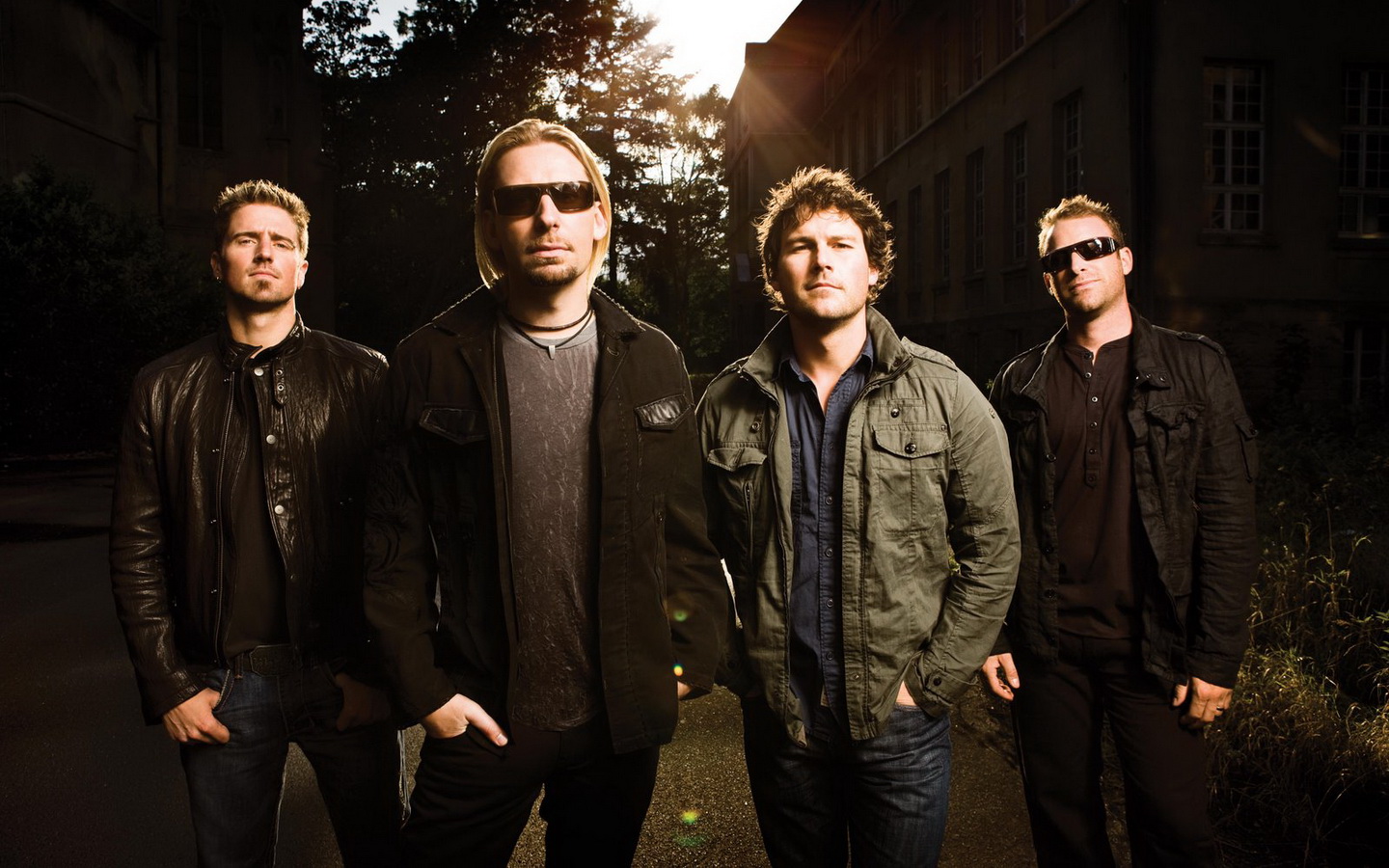
If you lived in the U.S. or Canada during the 2000's it's nearly impossible that you've never listened to or at least heard of the Canadian rock band Nickelback. Headlined by Chad Kroeger, a blonde Jesus/Nicholas Cage lookalike, they dominated the airwaves for nearly a decade after releasing Silver Side Up in 2001. This album featured their first and also biggest hit song "How You Remind Me", which has since been named as the most played song of 2002 with over 1.2 million radio spins. Silver Side Up has since sold 8 million copies worldwide and was certified 6x platinum in the U.S. and 8x platinum in Canada. Nickelback went on to sell more than 50 million albums and was named by Billboard magazine as the most successful rock band of the decade.


While having such an overwhelming amount of commercial success, Nickelback has also become one of the most hated bands of all-time. In my experience, it's gotten to the point that even the passing mention of the name Nickelback or Chad Kroger will almost instantly induce hysterical laughter or violent dry-heaving.
Ok, I guess that's a bit of an over exaggeration (the dry-heaving), but it's not far from the truth. When I mentioned to some of my fellow students I was planning to write an entire blog post about Nickelback most of them were appalled at the idea or thought it was a joke.

How can such a commercially successful band with so many hit songs be so synonymous with universal hate? I chock it up to three factors: lyrics & subject matter, general appearance, and finally they may just be too "standard".


Just briefly skim through the lyrics for songs like "Rockstar", "S.E.X.", "Next Contestant", or "Something in Your Mouth" and you'll have a pretty good understanding of Nickleback's music. Most of Nickelback's lyrics seem to be based on a simple and played-out formula of girls, wild parties, and being a general tough guy. Unfortunately, Nickelback often can't even make this simple formula for success seem genuine. Nickelback's lack of lyrical depth and storytelling ability is great for an audience of 7th graders who wear plaid shorts, AXE, and puka shell necklaces, but for a wider audience they fall short.

Among the many complaints people have about Nickelback, a common gripe is that people just can't stand how they look. Maybe it's Kroeger's ramen noodle-esque hair and terrible goatee or the others band members penchant for hair-gel and leather jackets, but there is something about the way that Nickelback looks that people just love to hate.

Finally, the most conclusive evidence for why Nickelback is so universally hated comes from Finland. A Finish student compile a list of reviews published in Finland from 2000 to 2014 and determined that critics despise Nickelback because they fail to separate themselves from other bands. Nickelback instead has positioned themselves as an extremely average band and more of an industry standard in the pop-rock genre.


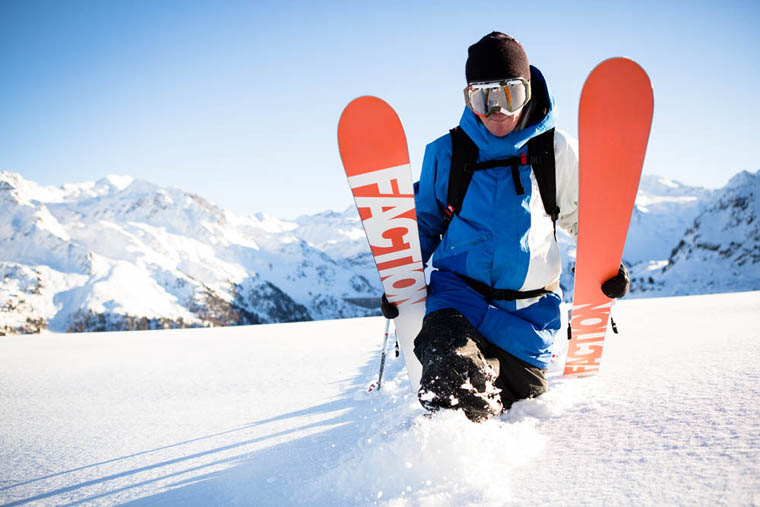
The Four P's of Alpine Ski Marketing

As the first snow of the year falls in Bozeman, I begin to look forward to the coming ski season and dream of "getting pitted in some gnarly blower," " tossing some steezy airs," and "hucking some naty bangers."


I have recently begun the search for a couple of new sets of skis, and in the process noticed a few interesting things about the way that skis are marketed. Most all skis cost around the same amount. In some cases, it's actually the lack of traditional marketing and advertising that draw people to certain skis. For these reasons, I've decided to dig a little deeper into the marketing of alpine skis.

Product
In the alpine ski market there are many different ways to separate your product from those of you competitors. The first of these is in the primary use of your ski. With so many different options; ranging from all-mountain, big-mountain, backcountry, park, racing, and moguls, just a slight tweak in a products design can dramatically change it's targeted use. A perfect example of this is the implementation of "rocker" or reverse-camber in modern ski design. This change in design has allowed for skis to perform much better in deep snow than the traditional camber ski, without sacrificing on-piste performance.
via GIPHY
When creating a ski I would argue the product is likely the most important part of it's marketing plan. A simple mistake or flaw in the design and a brand is likely to lose a customer for years to come.

Price
In the alpine ski market there are very few companies that try to differentiate themselves through price. A quick search through Evo or Backcountry will show most skis fall between the $600 and $900 range with some custom, racing, and high performance skis easily exceeding $1200. Prominent companies such as K2 and Rossignol are able to sell their skis for a slightly lower price because they manufacture many of their products in Europe and China, where as pricier companies such as ON3P, Moment, and Icelantic handmake their skis in the U.S. When creating a marketing plan in the alpine ski industry, price does not seem to be a big selling point for many consumers.

via GIPHY

Promotion
Promotion is very important in marketing alpine skis. Most companies sponsor yearly films, competitions, and support a team of athletes. Companies use these athletes to get their products shown at competitions, in films, and into print publications such as Freeskier. Many brands also use personal marketing techniques and send representatives around the country to promote and demo their products at resorts or shows. It is very important their skis get good reviews and testimonials so most companies submit their products to publishers who release gear guides at the beginning of every ski season. The final and possibly most important means of promoting a product is through word of mouth. The skiing community is pretty tight knit and many people buy products solely based off of suggestions from their friends. For this reason, it is important to make the best product possible.

via GIPHY

Place
Most skis are sold in one of two places, online or in a standard brick and mortar store. In order for a ski to gain traction, it is very important that they become available on a large website such as Evo or Backcountry. These retailers sell hundreds of different models and are able to reach a very large market that some companies would be unable to cover by solely stocking in ski shops.


Friday, October 7, 2016

The Marketing and Capitalization of Harambe's Death


"On May 28, 2016, a three-year-old boy climbed into a gorilla enclosure at the Cincinnati Zoo and Botanical Garden and was grabbed and dragged by Harambe, a 17-year-old Western lowland gorilla. Fearing for the boy's life, a zoo worker shot and killed Harambe. The incident was recorded on video and received broad international coverage and commentary, including controversy over the choice to kill Harambe."


R.I.P. May 28, 2016 


On that fateful day in May, the world lost one of its greatest heroes. Born in captivity, Harambe was known as a gentle giant to his keepers. Following his death, the public social media outcry became so large that the Cinicinatti Zoo even shut down its Twitter account to escape the never ending onslaught of Haramabe memes.


Out of a terrible tragedy, an entirely new market was born. Capitalizing on the popularity of Harambe in pop culture many enterprising individuals began making Harambe merchandise of all kinds. A quick search of the word "Harambe" in Amazon produces products ranging from simple t-shirts and coffee mugs, to lapel pins and custom Nike Elite socks.

Harambe Depot t-shirt

This phenomenon has grown so large that websites, such as Harambe Depot, that solely sell Harambe related products have been created to satisfy the consumers who are hungry to get a piece of the "Sweet Prince". Even though Harambe was killed nearly half a year ago he still remains a staple subject of memes, Twitter, and Instagram posts.


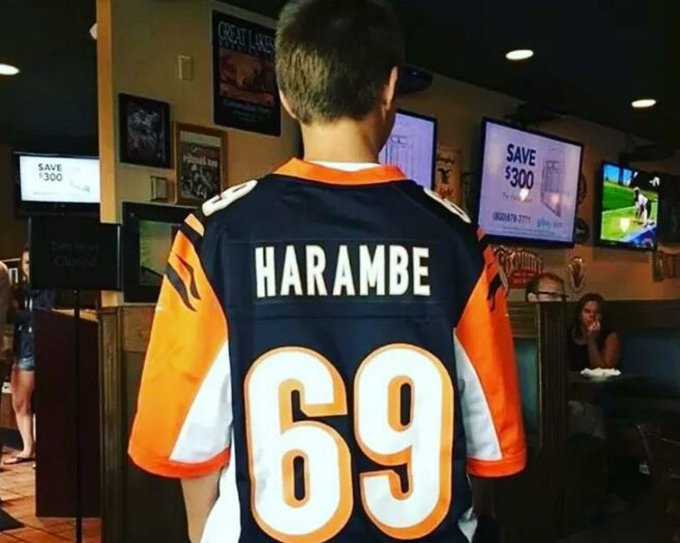
Harambe's legacy and popularity had even grown large enough that at one point the official NFL merchandise shop had temporarily blocked the sale of custom jerseys sporting his name across the back. This was later determined to be an accident resulting from faulty software, but for a few days many Harambe fans took to Twitter to share their outrage with the NFL for preventing them from supporting their idol.


I do wonder how much longer the Harambe "craze" will last. But for now, the market for Harambe related products continues to remain strong. We may never get him back, but at least we can all own a piece of his legacy.